







Rated 4.9+ stars by
verified, happy customers

If you're caring for a senior with dementia, finding a clear answer about what Medicare pays for at home often leads to more confusion. Overall, Medicare covers some dementia-related care at home, but that coverage is less comprehensive than what most families need.
Coverage is built around medical necessity rather than day-to-day help. There's an important difference between "home health," the skilled, doctor-ordered services Medicare covers, and "home care," the daily, nonmedical support many families with dementia need most.
That gap is why so many families end up piecing together support from multiple sources. Understanding what different sources cover for dementia patients helps show where resources are, and where there may be a need for additional care.
Medicare benefits for dementia patients fall into defined categories rather than one blanket approval for ongoing support.
Medicare Parts A and B home health benefits build on the broader Medicare home health coverage rules. These benefits are only available if a doctor certifies the need. Physician-ordered home health services may include intermittent skilled nursing from a Medicare-certified agency, such as:
Wound care.
Family caregiver education.
Physical, speech or occupational therapy.
Medicare sometimes covers a home health aide for dementia care, included alongside skilled care — but hours are limited and tied to the medical reason for the visit. Medicare's coverage of home healthcare for dementia often falls short of meeting full daily care needs.
Part B helps cover a cognitive assessment during an Annual Wellness Visit and a follow-up visit with a specialist to review results and create a care plan. Part B also covers durable medical equipment prescribed by a doctor for home use, including walkers, wheelchairs and hospital beds. For a senior with dementia who also faces mobility challenges, this benefit can make a real difference in day-to-day comfort at home.
Many prescription drugs prescribed for dementia fall under Part D plans, which require separate enrollment from Parts A and B, though coverage varies by plan. Many seniors diagnosed with dementia also take antidepressants, anti-anxiety prescriptions, or antipsychotics, which may be covered under Part D as well. A doctor can help determine if medication is part of the right treatment plan.
Understanding what Medicare can cover depends on eligibility. There are specific requirements to access those benefits, and not everyone with dementia automatically qualifies. Two things typically need to line up — homebound status and physician certification.
Homebound status requirements tie directly to the home health benefit, and the definition is more practical than clinical:
A doctor must confirm that the adult is homebound and that skilled nursing or therapy services are required to qualify for certain Medicare benefits. This face-to-face encounter must happen within 90 days before or 30 days after home care begins. The doctor signs a plan of care outlining what's needed, and the agency providing that care must also be Medicare-certified.
Beyond standard Medicare benefits, it's worth asking your doctor about the Guiding an Improved Dementia Experience (GUIDE) model. Launched by the Centers for Medicare & Medicaid Services in 2024, GUIDE is an eight-year pilot that connects patients with a dedicated care navigator, a 24/7 support line and family caregiver education and training.
GUIDE also partially covers respite care for dementia, and participating providers can bill GUIDE respite services to their Medicare Administrative Contractor (MAC) for eligible patients.
Eligibility comes down to a few factors:
Available in 47 states, the GUIDE program strives to keep people at home longer and improve the lives of both family caregivers and seniors with dementia.
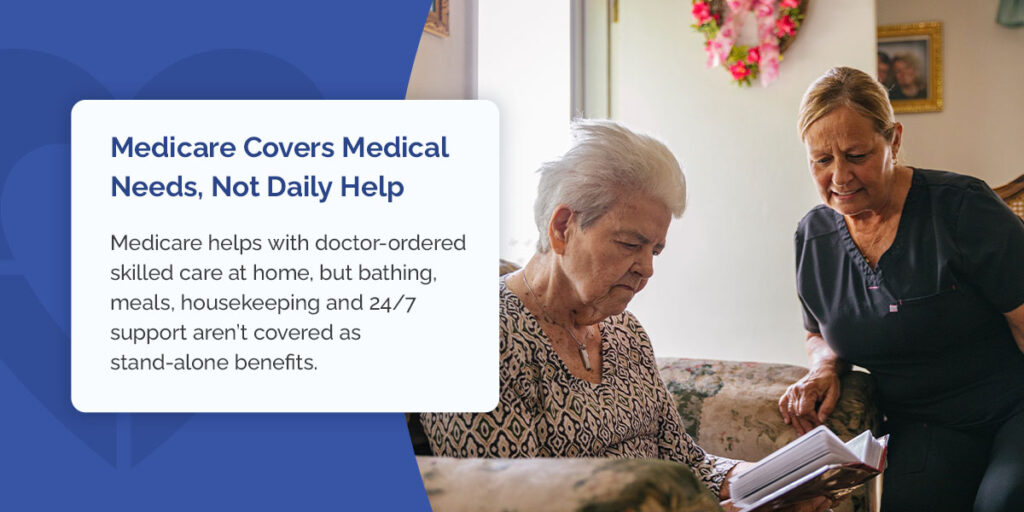
Knowing Medicare’s limits can help families understand when they may need additional support. Even when skilled care is involved, Medicare does not cover these needs as stand-alone benefits:
Even when Medicare covers skilled home health, the amount of aide assistance is limited and not meant to replace ongoing daily care. This often causes the cost of dementia care at home to climb quickly for families relying on Medicare alone.
Medicare is not the only option for in-home care, and for many families, financial help for family caregivers of dementia patients comes from a combination of a few sources.
Unlike Medicare, Medicaid can cover nonmedical in-home support for seniors who meet income and asset thresholds, one of several payment options for home care worth exploring. Home- and Community-Based Services waivers allow states to fund in-home care as an alternative to nursing home placement, though specifics vary by state. Families can contact their local Medicaid office to find out whether they qualify.
Some long-term care insurance policies help pay for nonmedical in-home care when the plan includes a cognitive impairment trigger or difficulty doing daily activities as a qualifying condition, though coverage terms vary widely. Review the insurance policy and confirm with the insurer whether a dementia diagnosis qualifies, and whether the agency must be licensed.
Where Medicare and other funding sources may leave a gap, Village Caregiving fills in with personalized in-home care for people living with dementia. We provide daily help through light housekeeping, stimulating companionship, assistance with recreational activities and consistent routines, along with the emotional benefit of a familiar, caring face.
Village Caregiving offers in-home care at predictable rates, with a flat hourly rate for nights, weekends and holidays. Reach out to Village Caregiving to talk through affordable in-home dementia care for your family.