
Home care is an excellent choice if you wish to spend your golden years in the comfort and convenience of your own home. This way, you don’t have to worry about adjusting to life outside the place you have grown to cherish and where you have made lifetime memories. To ensure you get the best quality of care at home, the government sets specific standards and regulations to oversee home care. While these regulations are for your benefit, they can sometimes be complex and overwhelming to navigate.
To help you understand how government regulations impact home care, Village Caregiving has compiled this comprehensive guide. It explores everything you need to know, from the quality of standards home care agencies must meet to licensing requirements.
Key Components of Home Care Regulations
Home care regulations are designed to cater to your need for safety, dignity and privacy as you age at home. The core components of these regulations are:
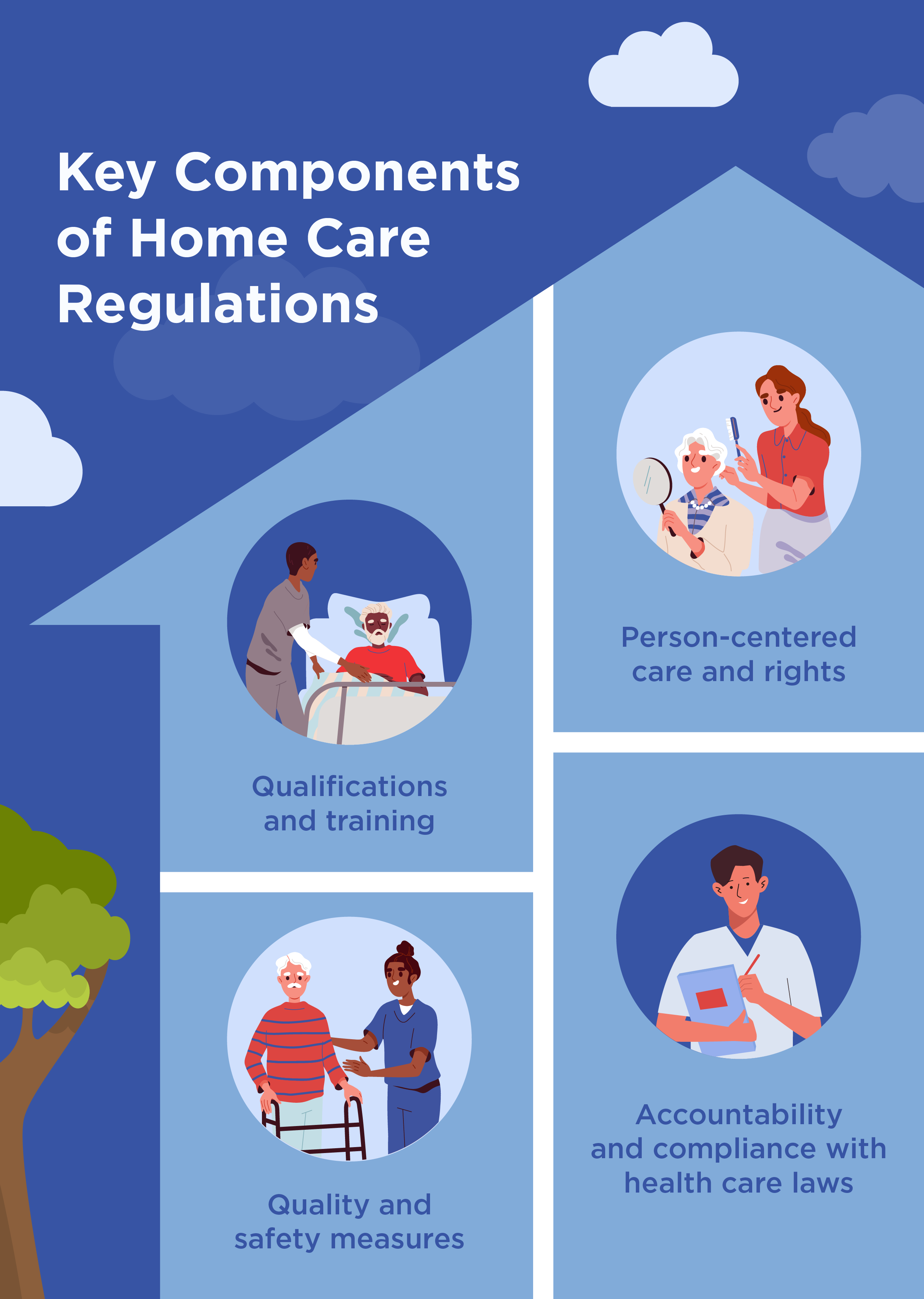
- Person-centered care and rights: Home care regulations aim to protect your rights as a person and help ensure you receive quality care. Consequently, in home care, family caregivers are obligated to honor your dignity and support your right to make choices — provided you have the mental capacity to do so.
- Qualifications and training requirements: The laws are in place to ensure that every family caregiver attending to your needs at home has the necessary qualifications and training. This stringent standard keeps you safe and in good hands.
- Quality and safety measures: This component plays a vital role in maintaining the highest standards of care. Home care regulations establish safety and quality measures to guide assessments, medication management and administration, emergency preparedness and other key areas.
- Accountability and compliance with health care laws: Family caregivers and home care agencies are obligated to comply with relevant health care laws. Take the Health Insurance Portability and Accountability Act (HIPAA) as an example. You are entitled to the protection of your privacy. This means everyone who comes into your home to care for you must have all the necessary HIPAA compliance training.
What Quality Standards Must Home Care Agencies Meet?
Home care agencies must meet quality standards shaped by a combination of federal and state regulations. These standards include:
- Bill of Rights: Home care agencies are required to protect and promote several rights you’re entitled to, like your right to privacy, which is protected under HIPAA.
- The plan of care requirement: Before a home care agency begins caring for you at home, it is required to create a tailored plan of care that addresses your specific needs and care requirements.
- Emergency preparedness: Home care agencies must create comprehensive emergency plans for your safety. This is to ensure you are not left vulnerable when natural disasters and other unforeseen events take place.
Benefits of Government Regulations for Home Care
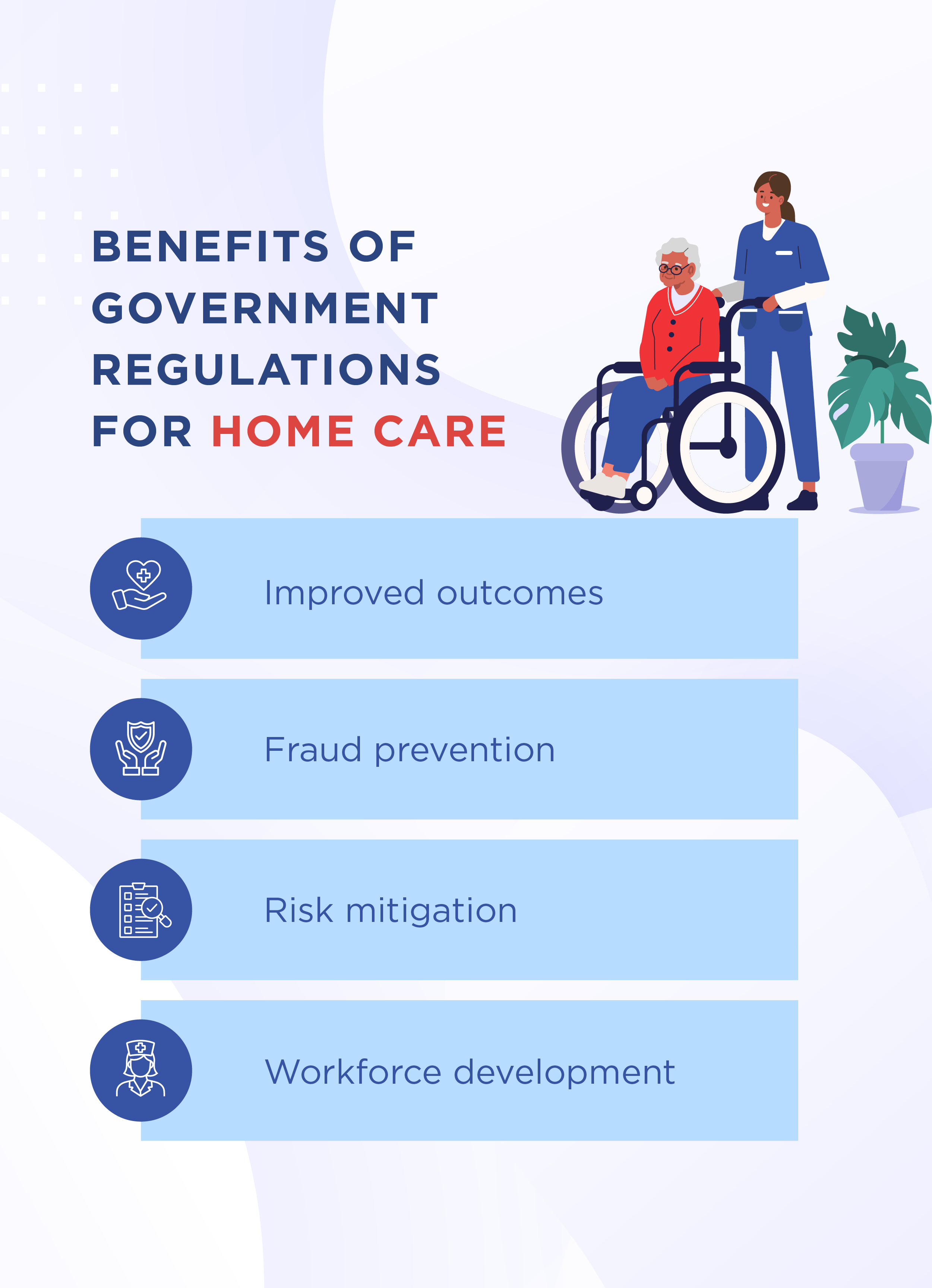
Government regulations are not just red tape. They are created for several reasons, all of which benefit both you and the home care agencies you partner with. Here are some essential benefits of these regulations:
-
- Improved outcomes: Regulations guide home care agencies toward delivering person-centered care. This means you can enjoy receiving the best support in the comfort of your own home.
- Fraud prevention: Through stringent screening and assessment processes, relevant government bodies proactively prevent fraud by excluding bad actors. This way, you can have greater confidence in being in the care of qualified professionals.
- Risk mitigation: Staying up to date with regulations protects home care agencies from fines, legal issues and potential litigation.
- Workforce development: Certain regulations governing home care services require ongoing training for their employees to remain compliant. This leads to continuous development, which in turn translates to improved services.
What Government Agencies Oversee Home Care Services?
At the local, state and federal levels, specific agencies oversee and implement regulations related to home care.
The Federal Level
Here are some of the primary federal agencies responsible for overseeing regulations that impact home care:
- Centers for Medicare & Medicaid Services (CMS): One of the essential roles of this agency is to establish Conditions of Participation (CoPs). The CMS exercises this role specifically in relation to agencies that receive federal funding. It sets health and safety standards that these agencies must meet to qualify for Medicare and Medicaid certification and reimbursement.
- Department of Health and Human Services (HHS): This agency, specifically through the Office of Inspector General (OIG), works to prevent fraud and exclude bad actors from participating in Medicare, Medicaid and other similar programs. To achieve this, the HHS conducts regular audits and evaluations.
The State Level
While federal agencies regulate funding, state-level agencies are responsible for licensing and certifications. They also oversee tasks such as staff training and regulatory inspections. The Department of Health for each state is primarily responsible for overseeing licensing for home care agencies. Some other functions these departments carry out include:
- Inspections and surveys: State Departments of Health typically conduct unannounced inspections and surveys to ensure home care agencies are maintaining the required standards.
- Enforcement: These departments are also responsible for imposing sanctions on defaulting agencies.
Third-Party Organizations That Enforce Home Care Standards and Regulations
Aside from government agencies, there are independent third-party organizations that review and accredit home care providers. These organizations use standards that go beyond the basic government requirements:
- The Joint Commission (TJC): This organization aims to improve the quality of care that health care organizations offer. To do this, it conducts in-depth reviews to evaluate home care providers’ compliance with the standards set by the CMS. Additionally, TJC helps home care providers create better systems to adhere to such standards.
- Community Health Accreditation Partner (CHAP): CHAP goes beyond setting standards that align with home care regulations. It also sets stringent standards to promote quality, safety and compliance.
Key Home Care Regulations and Laws
The following government regulations serve as guardrails, ensuring home care meets safety and quality standards for seniors.
HIPAA
HIPAA was signed into law in August 1996. Since then, this act has governed the way health care providers and covered entities, including home care agencies, collect, store, access and share sensitive medical information. To comply with HIPAA, home care providers must implement secure encryption tools to ensure your private information stays private.
Some HIPAA compliance rules that impact home care include:
- Security Rule: Home care agencies and professionals are subject to the HIPAA Security Rule. They must follow the set physical, administrative and technical safeguards for disclosing and using your protected health information (PHI).
- Privacy Rule: Under the HIPAA Privacy Rule, home care agencies are required to limit access to and disclosure of your PHI.
- Breach Notification Rule: If a breach occurs, home care agencies must notify you and the relevant authorities.
The Elder Justice Act (EJA)
Passed into law in 2010, the EJA encompasses several rights you’re entitled to as you age. One of its goals is to protect you from different forms of abuse you might be exposed to as a result of age-related factors. Family caregivers are closely involved in supporting your everyday needs.
As a result, the EJA mandates background checks and multiple screenings and assessments for home care professionals. The goal is to ensure that home care agencies hire highly qualified professionals, mitigating the risks of abuse, neglect and exploitation.
Certificate of Need (CON) Laws
The purpose of the CON laws is to keep state health care spending in check. It does this by approving new health care facilities and services only where they’re truly needed. This means that some states limit the number of home care agencies allowed to serve the need of seniors within the state.
While some argue that this is a restriction, it has several benefits that are reflected in the quality of services provided by home care agencies. For instance, CON laws in some states establish high standards that home care agencies must meet to obtain approval.
The 21st Century Cures Act and Electronic Visit Verification (EVV)
In 2016, the 21st Century Cures Act made it a requirement for states to adopt EVV systems for Medicaid-funded personal care services. EVV systems help track family caregivers’ visits in real time. Home care providers are required to record specific information that can be used to ensure accurate billing and oversight. Some of the benefits of this verification system include:
- Fraud prevention: The use of EVV systems is a reliable method for preventing Medicaid fraud. Since home care providers must account for scheduled visits, they can’t neglect their jobs to care for you and receive payment for services not rendered.
- Quality of care: EVV provides a live snapshot of your care, helping ensure caregivers arrive on time, complete each visit and deliver the support you’re meant to receive.
- Administrative efficiency: EVV systems eliminate the need for manual paperwork, enabling home care agencies to operate more efficiently and focus on more critical tasks.
- Accountability: With EVV systems in place, home care providers are held to higher standards of accountability. Knowing that their activities are being monitored keeps them working to provide prompt care as they should.
- Accuracy: Data collection is more reliable and accurate when home care providers use EVV systems.
Understanding Licensing Requirements for Home Care
Licensing falls under state jurisdiction. No two states have the exact same licensing requirements for home care agencies. However, each state requirement is thoughtfully designed to do the same thing — uphold a standard of high-quality care. Below are some important details to know about licensing.
State Licensing vs. Certification
Two terms you’ll likely come across when researching home care are licensing and certification. These two compliance measures serve different purposes in home care. Here’s how they differ:
- Licensing: This is a state-mandated prerequisite for agencies that offer professional care. The licensing requirements may vary based on the type of care agencies provide. In the case of nonmedical home care, some states require a different licensing procedure than that required for home health care agencies. Keep in mind that some states don’t require licensing for nonmedical home care services.
- Certification: Unlike licensing, certification is not government-mandated. However, home care agencies need certification to show they meet federal standards. Only then can they qualify to bill Medicare and Medicaid.
Staffing and Training Mandates
Different states set varying requirements for home care staffing and training. Some standard requirements include:
- Background checks: This is a common requirement for home care professionals across several states. Additional requirements in some states may include fingerprinting and drug testing.
- Caregiver training and certification: Each state has unique training and certification requirements for home care professionals, including the number of training hours and continuing education requirements.
The Impact of Government Regulations on Home Care
Government regulations impact home care in several ways, mainly in the following areas.
Cost
Compared to private hires, government-regulated home care agencies may charge higher rates. A contributing factor to this is that home care providers spend more money to stay compliant with government regulations than those in nonregulated settings. These compliance costs include training and EVV software costs.
In contrast, while it may be less expensive to partner with private hires, they come with certain financial and legal risks. In the long run, unregulated home care providers ultimately prove to be more expensive.
Quality of Care
A major focus of government regulations is the quality of care that home care agencies are expected to provide. It’s the reason for the emphasis on background checks and screenings, and continuous training for home care professionals. The effectiveness of these quality assurance measures is reflected in the quality of care you receive when you partner with regulated providers.
The opposite is usually the case with unregulated caregivers who are not subjected to background checks and government oversight.
Consumer Recourse
Government agencies do more than outline rules and standards for home care. They also give individuals and families structured ways to raise concerns, make complaints and seek resolution when things go wrong.
How to Verify Home Care Agency Compliance
Before partnering with any home care agency and letting family caregivers into your home, it’s crucial to confirm that they are compliant with the relevant government regulations. This step will help you filter out home care agencies that are not meeting the high standards necessary for quality care. Here are some steps you can take to verify home care agency compliance:
- Request necessary documentation: A vital detail to request from a home care agency is its state license number. A license number validates the agency’s legal right to operate in a state.
- Ask questions about EVV: An EVV system offers several benefits, as earlier outlined. To enjoy these benefits, ensure that the system is one used by a home care agency before partnering with them.
Age Safely in Place
Aging is a special time in one’s life. It’s a time better spent surrounded by comfort and care, while enjoying the companionship of loved ones. The last thing you should have to worry about is whether your home care agency has the capacity to provide the support you need and uphold your rights. This is why government regulations exist — to take the worries off your shoulders, ensuring home care agencies do things the right way.
Recent Comments